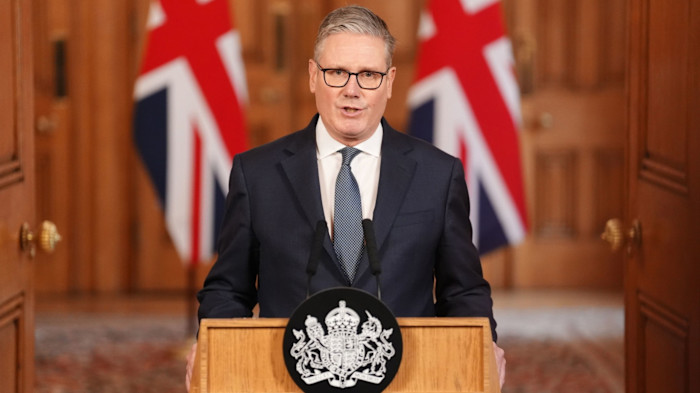
The US has been granted permission to use British military bases to launch attacks on Iranian missile storage depots and launchers, Sir Keir Starmer announced on Sunday.
London has given approval for RAF Fairford in Gloucestershire and the joint UK-US military base of Diego Garcia in the Chagos Islands to be used by Washington, according to British officials.
The UK prime minister said the move was “in line with international law”, as it underscored the “collective self-defence of longstanding friends and allies”, and would help safeguard British lives and interests. Gulf nations had urged London to do more to protect the region, he added.
In a video clip posted on X, Starmer stressed his position on UK involvement in the US and Israeli strikes against Iran had not shifted and that the British military would not participate in offensive attacks.
Starmer has declined to endorse the strikes on Iran, which Britain believes to be in breach of international law, as the UK attempts to avoid being drawn into the conflict.
However, Starmer highlighted “sustained attacks” by the Iranians against a raft of Middle East countries “who did not attack them”, with targets including civilian infrastructure such as airports and hotels where British citizens were staying.
UK officials believe at least 200,000 British nationals, many of them on holiday or in transit, may be in the Middle East and have asked them to “register their presence” for a possible evacuation.
Setting out the risk to UK troops in the region, Starmer said an Iranian attack on a military base in Bahrain on Saturday narrowly missed hitting British personnel.
The UK prime minister said the only way to stop the threat from Iran was to destroy the missiles at source or their launchers. “The US has requested permission to use British bases for that specific and limited defensive purpose,” he added.
London had been reluctant to allow Washington to use Diego Garcia in the Indian Ocean, or RAF Fairford, to launch initial strikes against Tehran, reflecting British officials’ concern that the move was against international law.
The UK’s role will be limited to “defensive actions” in the region, Starmer said. “We all remember the mistakes of Iraq and we have learned those lessons,” he added, as he reiterated his support for a negotiated settlement on Iran’s nuclear programme.
Starmer’s government published a brief summary of its legal advice following his statement, centred on its argument that the latest move supported the UK’s defence of “itself and its position in the region”, as well as Britain “acting in the collective self-defence of regional allies who have requested support”.
The summary stated: “It does not signal the UK having any wider involvement in the broader ongoing conflict between the US, Israel and Iran.”
The Liberal Democrats demanded Starmer set out the legal case in full and put his decision to a vote in the House of Commons on Monday.
“No matter how the prime minister tries to redefine offensive as defensive, this is a slippery slope. He must not let Trump drag Britain into another prolonged war in the Middle East,” Lib Dem leader Sir Ed Davey said.
In a joint statement earlier involving Starmer, French President Emmanuel Macron and German Chancellor Friedrich Merz, the leaders of the so-called E3 nations asserted their right to enable “necessary and proportionate defensive action to destroy Iran’s capability to fire missiles and drones at their source”.
It also emerged that Britain has begun drawing up options for a mass evacuation of its citizens from the Middle East “by air, land or sea”.
One official said there were no current plans for a “small boats style evacuation” of citizens — a reference to the 1940 rescue of troops from Dunkirk — but added: “We have to be thinking about all options.”
Most of the affected people are in the United Arab Emirates. The process of registering their presence is part of an operation to identify those who may be most vulnerable — for example the elderly or infirm.
With airspace in the region closed, one possibility would be to take people in the Gulf on buses to Saudi airports, including Riyadh, a journey of around 10 hours. Another option would be a journey by boat to Cyprus.
UK nationals in Bahrain, Israel, Palestine, Qatar, United Arab Emirates and Kuwait have been urged to register.
More than 94,000 people had registered by Sunday evening, UK officials said, in what is seen as one of the biggest ever British consular operations. So far they have been told to stay put and follow advice on taking shelter.
Meanwhile John Healey, UK defence secretary, on Sunday repeatedly refused to endorse the strikes on Iran by the US and Israel. Britain’s stance has been much more ambivalent than Canada and Australia, which have backed the military action.
Dame Priti Patel, shadow foreign secretary, who was in Washington last week, said the US administration had been “very, very unhappy” with Britain, partly over the Diego Garcia air base.
She said the Tories fully supported the strikes on Iran and Nigel Farage, leader of Reform UK, had earlier urged Starmer to allow the use of British military bases and “support the Americans in this vital fight”.
The prime minister is caught in a politically precarious position domestically, however, with calls from the left for him to openly criticise the US-Israeli attacks.
Additional reporting by Charles Clover
Read the full article here