
Stay informed with free updates
Simply sign up to the UK financial regulation myFT Digest — delivered directly to your inbox.
British banks are losing ground to less constrained private credit groups and Wall Street rivals, two bosses have claimed to senior lawmakers.
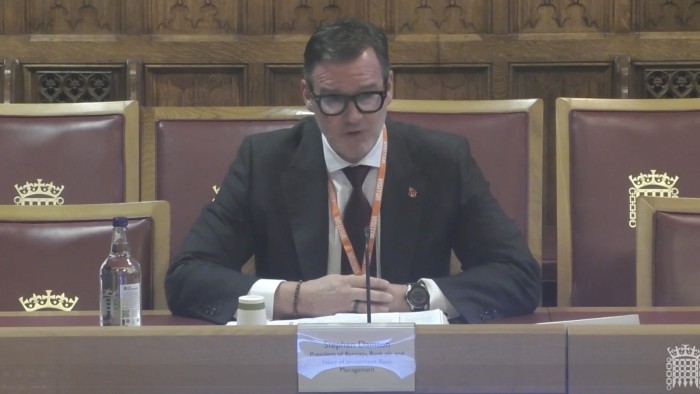
Senior executives of HSBC and Barclays told the House of Lords financial services regulation committee on Tuesday that onerous capital rules were putting them at a disadvantage against the fast-growing private credit groups that are subject to much lighter requirements.
The comments by the bankers underscore how British lenders are intensifying their lobbying push in response to an aggressive cutting of US regulations, as well as a Bank of England review of UK capital requirements.
Private credit groups have grown rapidly since the 2008 financial crisis, particularly in the US, providing a rising share of loans to companies that they often then package up and sell to institutional investors.
This has prompted concern among regulators, who have less oversight of private credit groups, as well as among bankers. Both have drawn parallels with the run-up to the 2008 financial crisis.
Michael Roberts, head of corporate and institutional banking at HSBC, said the private credit market was growing 15 per cent a year, fuelled by having relatively light rules on capital and liquidity, allowing its members to provide loans at cheaper rates than banks.
HSBC’s capital requirements were five times higher when lending to small and medium-sized companies than when it provides funding for private credit groups to finance loans to the same businesses, he said.
“There is a considerable difference between lending into the private credit fund on that diversification and securitisation basis versus lending directly to the client itself,” he said.
Banks are subject to risk-weighting rules that determine how much capital they allocate to different types of loan depending on their riskiness.
HSBC’s loans to small and medium sized companies attracted a 100 per cent risk weighting, Roberts said, while its investments in loans to the same companies through a private credit securitisation vehicle attracted only a 20 per cent risk weighting.
Stephen Dainton, head of investment bank management at Barclays, called on regulators to be aware of the vast scale of private credit groups such as Blackstone, Apollo and BlackRock, which are listed in New York with a combined market value over $400bn.
“We should not underestimate that scale,” he said. “Understanding that scale I think it is important to reflect on whether or not the regulatory framework has to observe that in a much more granular fashion.”
HSBC said in a statement after the hearing that “when banks lend to private credit funds, they are normally taking secured and/or senior positions, so have considerable insulation from losses.”
US regulators have signalled plans for an unprecedented easing of key banking rules, which is expected to free up almost $140bn of capital for Wall Street lenders — equivalent to an extra $2.6tn of lending capacity — according to research by consultancy Alvarez & Marsal.
Roberts said US deregulation would increase pressure on UK authorities to ease rules for British banks.
The BoE this year launched its first review of capital requirements for British banks since 2019, including an assessment of whether their overall target is set at the right level, with the results due to be announced next month.
Dainton warned some countries could diverge from the Basel agreement on bank capital that is meant to ensure a level playing field for lenders globally. The UK and EU have delayed their Basel reforms while waiting for the US to decide how it will implement them.
Dainton urged UK regulators to ensure the country’s banks “are not disadvantaged if there are any changes in terms of regulation at the bank level”.
Roberts called on regulators to force private credit groups to disclose much more information. He said: “You would have to approach it in a somewhat similar way to the way you approach banks in terms of the information you provide.”
The Bank of England declined to comment.
Read the full article here