

A lot of uncertainty remains with regard to the incoming Trump administration and continued talk about possible tariffs. But the anxiousness may lead some investors to uncover opportunities.
Chris Lau, Investing Group leader behind the DIY Value Investing service at Seeking Alpha, says investors may find gems among companies operating in the basic materials sector. Metals and mining firms outside the United States, which have been beaten down over time, now appear attractive.
Lau, who has been a Seeking Alpha analyst since 2009, covered the collapse of EV companies in 2024, including the Fisker bankruptcy, and how other EV companies worked to stabilize their businesses. His takeaway for 2025 is simple: Tesla (TSLA) will continue to dominate.
What’s next for AI-focused companies is also part of Lau’s 2025 outlook, which follows below:
Seeking Alpha: What are your macroeconomic concerns in 2025: Are there countries or regions, or even stock sectors, that may face challenges in the next year and beyond?
Chris Lau: In late January, investors should expect tariff threats to lead the macroeconomic fears ahead. Stock markets already priced in the potential impact of punitive tariffs levied against U.S. trade partners Canada (EWC) and Mexico (EWW).
While U.S. trade with China (KWEB) will also deteriorate, the Chinese government already announced aggressive stimulus programs worth $1.4 trillion. It also cut interest rates in October and is ready to cut more. As a result, e-commerce firms like Alibaba (BABA) and JD.com (JD) bounced back. PDD (PDD), which owns Temu, continued to fade. Its costs are rising as competition and cost of revenue both increased in the quarter.
Conversely, shares in the Canada and Mexico exchange-traded funds lost momentum in mid December. Markets expect the U.S. will come out ahead as trade negotiations begin.
The Canadian government planned to spend $1.3 billion over six years to strengthen border security. However, by offering few details on how it will spend the money, President-elect Donald Trump may still impose a possible tariff of up to 25% on all Canadian imports. Canada’s Prime Minister has only 16% of voter support. Without strong leadership, the 10 provincial leaders may not have a unified response to impose counter-tariffs against the U.S.
Investors who want to bet that the markets priced in Canada’s export slowdown may look at the basic materials sector. Teck Resources (TECK) is down by around 20% in the last quarter, as selling accelerated in the last month. Canadian National Railway (CNI) is on a year-long downtrend. At $101.11, the stock is 2.2% above its 52-week low. Canadian Pacific Kansas City (CP) is also hovering near its low. However, CP stock trades at a forward price-to-earnings ratio of 24.47 times. Its Seeking Alpha valuation quant grade is a D-. The railway firm does not offer a rich dividend, either.
Seeking Alpha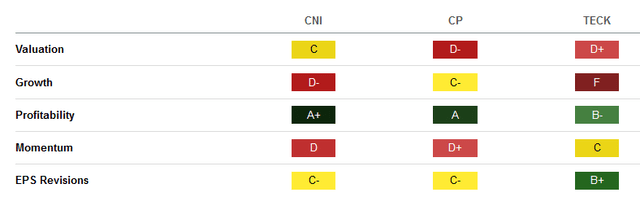
Investors seeking dividends in Canada may consider the bank stocks. Among Royal Bank (RY), Bank of Nova Scotia (BNS), TD Bank (TD), CIBC (CM), and Bank of Montreal (BMO), Royal Bank is the best-of-breed financial institution. It’s the largest Canadian bank by market capitalization at $171 billion.
Seeking Alpha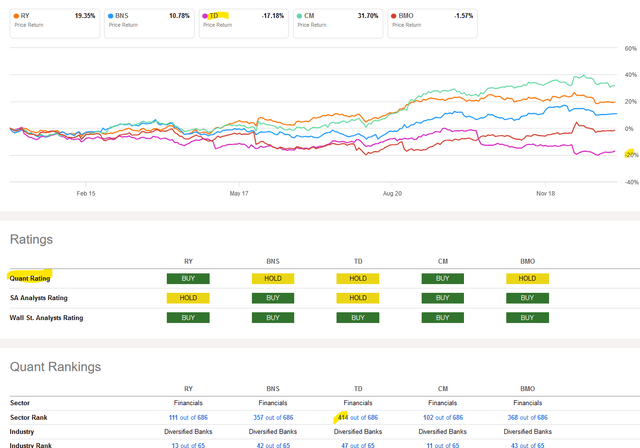
TD stock trades at a discount, scoring an A- on valuation. The firm resolved a court case with regard to alleged money laundering violations in October. It agreed to pay a $1.8 billion penalty.
Seeking Alpha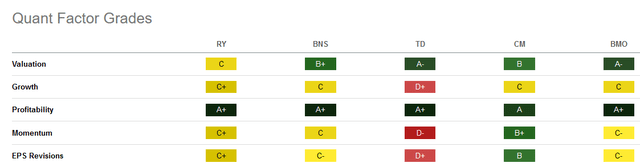
Investors should avoid Canadian telecoms. After regulators denied BCE (BCE) relief, the firm unexpectedly spent its C$4.2 billion windfall from the sale of Maple Leaf Sports & Entertainment. It acquired U.S. firm Ziply Fiber for C$5.0 billion. BCE executives said to shareholders that it would only pause its streak of dividend increases. However, instead of paying down its high debt level, it may cut the dividend payout instead to service that obligation first. BCE shares currently yield 12.5%.
Seeking Alpha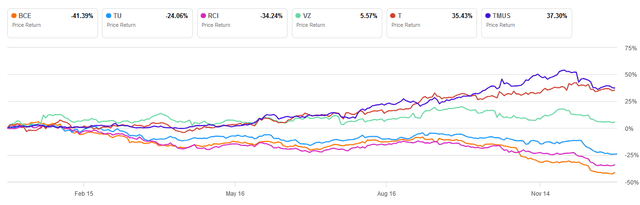
Above: BCE performed poorly alongside Rogers Communications (RCI) and Telus (TU). T-Mobile (TMUS) and AT&T (T) performed the best. Verizon Communications (VZ) gained around 5.6%. VZ stock performed poorly after the firm announced it would buy Frontier (FYBR) for $20 billion.
Seeking Alpha
Seeking Alpha: What are the stock buys for 2025 as (speculative) tariffs come into effect?
Chris Lau: Ahead of the tariff rhetoric subsiding in January, investors may start positions in beat-up metals and mining firms outside of the U.S. Vale (VALE) trades at a discount because the firm is often at risk of paying concessions to the Brazilian government. On Dec. 30, it paid $1.8 billion to renegotiate two railway contracts.
In the iron ore sector, Cleveland-Cliffs (CLF) potentially bottomed at $8.99 yesterday. Markets are worried about weak global markets in 2025, selling off steel stocks in the process.
Seeking Alpha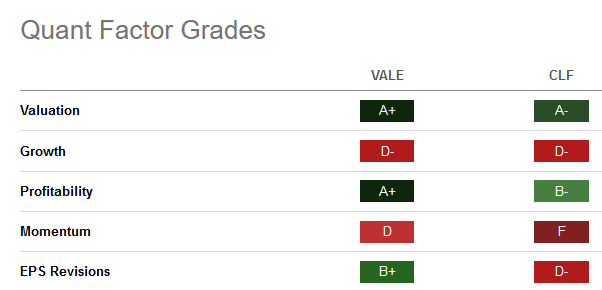
Investors should continue to avoid automotive firms. Possible future tariffs against Mexico may hurt General Motors (GM) and Ford (F). The firms have plants and facilities in the country, so they may face higher costs.
Seeking Alpha: What happened to last year’s EV bubble? And what can investors expect for the EV business in 2025?
Chris Lau: In the EV flop, discussed last November 2023, investors lost money in firms with weak balance sheets. Fisker filed for bankruptcy, while Polestar Automotive (PSNY) lost 51.1% in 2024. Lucid Group (LCID) raised $1.67 billion in October from Ayar Third Investment Company, an affiliate of Saudi Arabia’s Investment Fund. This minimized the drop in LCID stock. Similarly, Rivian (RIVN) formed a trading range of $10- $15 this year. Volkswagen (OTCPK:VWAGY) invested $1 billion in Rivian. It planned to invest up to another $4 billion.
Investors should expect Tesla to dominate the EV market. It still has the first-to-market advantage. In addition, CEO Elon Musk may benefit from potential looser regulatory changes in the EV industry.
Despite Tesla’s advantages and stock strength, the firm has two major headwinds. First, consumers indicated weaker demand for EVs in September. In the report, 21% indicated they wanted hybrid vehicles. They will opt for fewer features in return for a lower price. Second, Chinese EV firms will continue to flood the global market. BYD (OTCPK:BYDDF) should perform well in the year, as will Li Auto (LI). In Q3, Li posted a GAAP EPS of $0.38. NIO (NIO) lost $0.30 a share while XPeng (XPEV) lost $0.22 a share.
Seeking Alpha: Is AI in a bubble? Or are there opportunities that still exist in this space?
Chris Lau: If investors look at current price-to-earnings ratios, then Nvidia’s (NVDA) “F” on valuation and Broadcom’s (AVGO) grades would imply a valuation bubble. Nvidia earned the price premium since it has a strong moat. Its investment in CUDA cores widens its lead over Advanced Micro Devices (AMD) and Intel (INTC).
The race to first place is never over. Nvidia enjoys strong profit margins by selling desktop GPUs at premium prices. They typically have only 8GB of GDDR memory. Intel may disrupt Nvidia’s CUDA premium by offering a budget GPU that has 24 GB of memory. Intel might absorb a loss per unit sold at the expense of gaining market share. After validating a proof of concept in the desktop PC AI space, it may take on AMD and Intel in the Server AI market.
Speculators may ride the AI momentum with Bigbear.ai (BBAI) or in quantum computing with Rigetti Computing (RGTI) and Quantum Computing (QUBT). RGTI stock has a strong quant industry ranking.
Conversely, investors who expect AI-related chip demand growth may consider Taiwan Semiconductor (TSM) and ASML (ASML).
Seeking Alpha: How should investors position themselves with all the uncertainty headed into 2025?
Chris Lau: When the Federal Reserve cut interest rates by 100 bps points, the U.S. Treasury bond market yields rose by around the same magnitude. Investors may trim, but not entirely sell, their biggest winning positions. Accumulate Treasury bond ETFs when the yield is near 5.0%. The 7-10 Year Treasury Bond ETF (IEF) closely mirrors that of the US 10-Year Treasury (US10Y). The iShares 20+ Year Treasury Bond ETF (TLT) tracks the US 30 Year (US30Y).
Seeking Alpha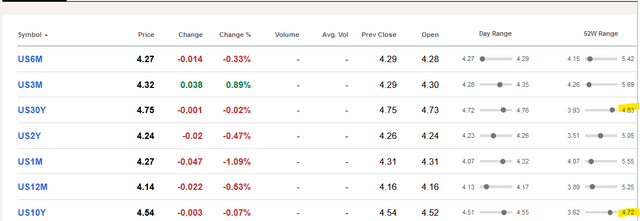
In addition to holding more U.S. cash through the U.S. Dollar Index (DXY) and US Dollar Index Bullish Fund ETF (UUP), the 0-3 Month Treasury Bond ETF (SGOV) yields 5.10%.
Editor’s Note: This article discusses one or more securities that do not trade on a major U.S. exchange. Please be aware of the risks associated with these stocks.
Read the full article here